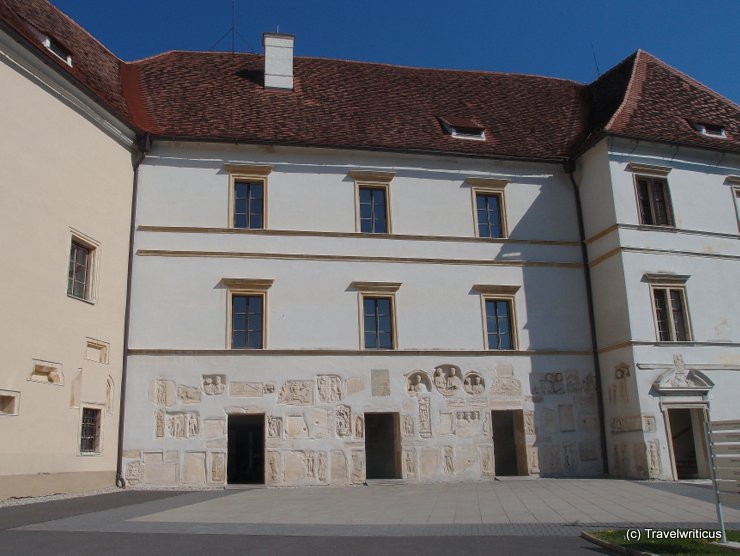
After walking through the Templar Museum at Lockenhaus Castle, you should also visit this mysterious room. It is supposed to have been a sacred site of the Templars. Other voices say it was just a cistern.
Browse through your travel destination!

After walking through the Templar Museum at Lockenhaus Castle, you should also visit this mysterious room. It is supposed to have been a sacred site of the Templars. Other voices say it was just a cistern.

The manhole covers in Rostock display the coat of arms of the city. The coat of arms dating back to 1367 depicts a golden griffin of a blue field (representing the former princes of Rostock) with bars of silver and red (the colours of the Hanseatic League).

Right next to the railway station of Zell am See, you have this view of the Zeller See (Lake Zell) and the mountains nearby. Though the lake is large, it completely freezes in winter and is used for winter sports.

Hohenzollern Castle in Heiligendamm is more a guest residence than a castle. Grand Duke Paul Friedrich commissioned the building to accommodate his noble guests. It saw its completion in the 1840s.

This exhibition hall for contemporary art stands near the Wiener Hauptbahnhof (Vienna Central Station). First, it was named 20er Haus. After its remodelling from 2009 to 2011, its name changed to 21er Haus, reflecting the new century.

The church was constructed by the mendicant order of the Franciscans. That explains why there is no tower. Even though it isn’t a real cathedral, the people of Halle still call it a Dom (Cathedral).

There is still a tramway running in the Austrian city of Gmunden. One of the tramcars is even moren than 100 years old. On several days a year this GM 100 dating back to 1898 is on your service.

The former armoury (Zeughaus) of Nuremberg saw its construction by Hans Dietmayer in 1588/89. After bomb damage during World War II, a reconstruction finished in 1954/55.

While walking along the town square of Schärding, I came across the “Silberzeile”. This attraction is a row of coloured houses in the style of the late Baroque period. In earlier times, each colour symbolised a particular guild.

On a historic locomotives parade in Fürth, this engine of the German Class 41 was one of the stars. Despite being built in 1940, the freight locomotive 41 360 seemed particularly juvenile and elegant.

This sundial shows two depictions of Bruck an der Mur, a city in the Austrian state of Styria. In the upper part of the mural, you see Landskron Castle and the former town walls.

The New Town Hall (Neues Rathaus) of Hanover (Hannover) saw its construction during the era of Wilhelm II in an eclectic style. It opened in 1913. The observation deck in the dome is accessible via a remarkable elevator.